As faithful readers (I think there are two of you) know, I have a bit of an obsession
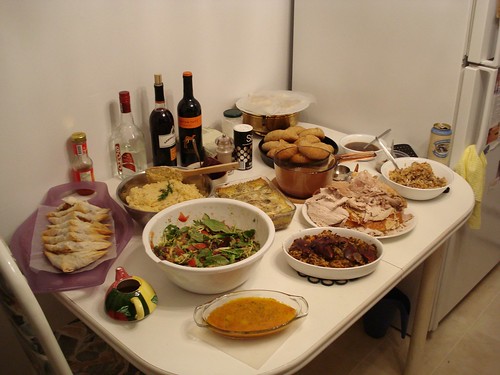
with food. Regrettably, I've neglected quite a lot over the past few months, and rather than skip it entirely, I'm going to try to fit it all together in a Very Special Thanksgiving Episode of
think deviant. Here goes:
Main Course: The Turkey (food miles)
I've expressed reservations about the environmental aspects of the local food movement
before. Local food puts money into the local economy, and that's a good thing. But one reason regions specialize is to take advantage of local resources, and these are often best suited to particular tasks. Areas which are marginal for oranges might be ideal for blueberries, for example. Locals should certainly buy local berries if they're lucky enough to live there, but why should they buy local oranges.
The middle part of the thousand-mile journey a papaya makes to my plate is the most efficient part. The least efficient part of the journey? The hundred miles on either end, where the food goes from farm to transportation hub and then from transportation hub to market by truck. Worse still (by unit weight) is the trip it takes from market to table. I don't do so bad myself, since I use public transit and a backpack.
The Food Mile measurement is helpful in clarifying the difference between, say, a local farm that is not organic and an organic farm that is not local. So, if you go to Whole Foods, they might have organic apples, shipped from a thousand miles away. Is this better than having pesticide-laced apples grown locally? [more here]
For example,
lamb raised on New Zealand's clover-choked pastures and shipped 11,000 miles by boat to Britain produced 1,520 pounds of carbon dioxide emissions per ton while British lamb produced 6,280 pounds of carbon dioxide per ton, in part because poorer British pastures force farmers to use feed. [again, more]
Of course, an environmentalist probably ought to reconsider eating lamb in the first place (read on).
Stuffing (you are what you eat)
I think that food is very important, and I worry that people forget about it in favor of making money and advancing their careers. I think that it is good to have a personal connection with what you eat, whether it's by preparing your meals yourself, eating vegetables from your garden, or supporting a local dairy farmer. I think that researching and practicing organic and sustainable farming techniques is an important social issue, and that the consumer has a responsibility to support farmers who use such techniques.
So says
Kate Lee, who helpfully provides a pragmatic list of what goes into food choices: money, taste, nutrition, time/convenience, and source. I hasten to add the social and moral dimensions.
Mashed Potatoes (supermarkets)My old high school is being torn down to make room for a supermarket. The site is just a terrible location. It abuts one of Augusta's two awful traffic circles (a bridge links the two), a nightmare for pedestrians and cyclists, and a wholly confusing experience to visitors, who usually don't realize that the inside lane always has the right of way and that motorists entering the circle must yield to those already in the rotary. The state ranks the roundabouts as the top two sites for fender-benders each year, and this played into the relocation of the high school up the hill and away from the traffic. Hannaford has wanted to the spot for years. For some reason, it thinks the wedge between two rotary feeders is the ideal spot. With no traffic signals, daily commuter traffic out of the city backs up from one circle across the bridge and around the second circle each day at rush hour--just the time most folks want to stop off at the grocery store. But now I hope the project succeeds.
Maine's largest supermarket chain, Hannaford, announced it is building the first completely "green" supermarket. It will meet the highest industry environmental standards and will be the first "green" grocery store in the world. The design of the building includes solar panels, geothermal heating and cooling, energy efficient lighting, a recycling program and a rooftop garden designed to insulate and control rainwater. In addition, the contracting company building the new Hannaford in Augusta is seeking to recycle 95 percent of the old high school it is tearing down on the proposed site.
[as reported in my alma mater's
school paper]
Gravy (the Farm Bill) The 2007 Farm Bill allocates some 286 billion dollars (over five years). It's a massive document, impossible to sum up in a few words. So how about a thousand from
Ezra Klein?

Subsidies are not an innately bad thing. They are the economic carrots encouraging the behavior Congress prescribes. The trouble is, Congress isn't necessarily the best judge of appropriate behavior. There are a lot of things to consider.
World's Fair begins with these:
1. crop growth practices affect biodiversity, water use, and environmental health--locally and nationally;
2. chemical usage on crops in the form of pesticides, herbicides, and fertilizers has severe environmental consequences, the degree of which we need not elaborate here;
3. decisions about genetically modifying seeds, the role such seeds will play following genetic drift in coming years and decades, and the concomitant issues of control and power between agri-business and local farmers, have ramifications for all of us;
4. crop shipment, to, from and across America, affects our use of fossil fuels and output of greenhouse gases; and
5. food eating habits by Americans have an affect on future personal and public health issues, as in, what diseases they will face in the future.
Politicians have other concerns as well. A few years ago, I heard House Democrat Tom Allen speak of the dairy subsidy in Maine as a choice we make to protect a way of life with the added benefit to bolster a self-sufficient food economy in a time of global uncertainty due to terrorism. He's probably right on both counts, but here on the ground, the difference is clear: here in Toronto, it costs me nearly $4 for a half-gallon of milk. Back home in heavily-subsidized Maine? $2.
Here's
more on small farms and subsidies.
The Sides (organic movement)
The sustainable farming practices of pastoral England did not always import well to the United States. In the established communities of New England, social ties greatly constrained potential misuses of common lands; deeds specified grazing rights and encourages crop rotations. As settlers moved west, the social constraints -- and experienced older farmers -- simply weren't a consideration, and more rapine practices dominated. Railroads, land speculation, vast open tracts, and massive government water projects accelerated westward settlement/plunder. As a result of decades of unsustainable cash crop manufacture, the 1920s drought literally blew millions of tons of topsoil away. Big, mechanized agricultural concerns consolidated land ownership, and efficiency reigned as the governing ethic for American farming. [Such a gloss pains the historian in me. Every American should know this story, but few do. Worster's Nature's Economy is essential, if Marxist, background.]
DDT, pesticides, and fertilizer runoff helped agriculture recover from the devastation of the Dust Bowl, but the deadly side-effects trumpeted by Carson's Silent Spring signaled an ideological shift in America's thinking about its relationship with itself (that is, society and environment, or that great social construct, "wilderness"). After decades, organic farming is hitting the mainstream. Yet at the same time,
conventional farming is starting to look a lot like organic farming.
The earthworm-rich soils, so prized by organic farmers, are being achieved through contemporary no-till (or no-plough) techniques. In Australia, most farmers use rotation to get crops out of synchronisation with weeds and to return nutrients to the soil. Natural predators are being used to control pests, and companies such as Dow Chemical are producing safe, short-acting pesticides. In fact Dow's latest pesticide, Spinosad, is also happily used by organic farmers because it is naturally produced by bacteria. [more]
In other words, agribusiness has rid itself of its greatest ills, yet retains its greatest efficiencies. Experiments in organic, local, and fair trade economies are necessary, and each represents a considerable and important ethos agriculture has yet to fully absorb, but I have to wonder: is it time to give the free-market food market another chance?
Pumpkin Pie (food labels) Finally, these days it seems to take some kind of special training to understand food labels. Free range? Organic? Organic Plus? Wild? Natural? McSweeney's has the perfect
glossary:
Local. This is food grown by local farmers who dislike you because you're living in the subdivision that used to be prime farmland owned by their grandparents. Local food may be purchased at farm stands, which is where your children will someday be buying pot. If you buy local organic foods, you may skip dinner altogether and ascend directly to heaven, where you'll be greeted by 72 varietals of virgin olive oil.
 Much of what goes on on a site like facebook can be considered, by the cynical among us, signaling behavior--that is, because we have such freedom of choice as to what we include or elide, virtually everything on facebook counts as a personal advertisement. Most native English-speakers have read "Hamlet" once or twice in our lives, but not all of us would include it as a favourite book. For those who do, it serves as a signal, an affiliation, or an invitation. Thanks to attentions from the more quantitatively inclined, "Hamlet" also signals an SAT score in the 1000 range. The idea is to mine the apparently harmless public data facebook collects for various affiliations, like "the 10 favorite books at the University of Toronto," and presume a correlation with other known characteristics of that affiliation, in this case the published average SAT levels. Finally, we can look at our own facebook friends to see if any of them lists "Hamlet" as a favourite book. If they do, then by the improper logic that accompanies all signaling behaviour, their SAT scores must be in the 1000 range. Lolita, One Hundred Years of Solitude, and Crime and Punishment are smarty-pants signals (1300+ SATs), though I imagine that the release of a film for One Hundred Years will be a near-term spoiler.