
Showing posts with label best of net. Show all posts
Showing posts with label best of net. Show all posts
Thursday, 30 September 2010


Saturday, 25 September 2010
Thursday, 16 September 2010
why things are broken
TED is famous for its great talks. But sometimes, people give great talks at other venues. Fortunately, TED grabs up these talks too, and calls them "Best of the Web" talks.
Here's a great one by Seth Godin on why so many things in the modern world seem broken.

Seth Godin: This is broken
Friday, 23 May 2008
best of net: BODY RITUAL AMONG THE NACIREMA
In this, the fourth installment of "best of net," I reproduce a section of Horace Miner's "Body Ritual among the Nacirem," originally published in American Anthropologist 58:3, June 1956. It is a seminal work in the field of anthropology, and though by now a bit dated, is nevertheless an instructive read. As always, go read the original.
The anthropologist has become so familiar with the diversity of ways in which different people behave in similar situations that he is not apt to be surprised by even the most exotic customs. In fact, if all of the logically possible combinations of behavior have not been found somewhere in the world, he is apt to suspect that they must be present in some yet undescribed tribe. The point has, in fact, been expressed with respect to clan organization by Murdock (1949: 71).[2] In this light, the magical beliefs and practices of the Nacirema present such unusual aspects that it seems desirable to describe them as an example of the extremes to which human behavior can go....
Nacirema culture is characterized by a highly developed market economy which has evolved in a rich natural habitat. While much of the people's time is devoted to economic pursuits, a large part of the fruits of these labors and a considerable portion of the day are spent in ritual activity. The focus of this activity is the human body, the appearance and health of which loom as a dominant concern in the ethos of the people. While such a concern is certainly not unusual, its ceremonial aspects and associated philosophy are unique.
The fundamental belief underlying the whole system appears to be that the human body is ugly and that its natural tendency is to debility and disease. Incarcerated in such a body, man's only hope is to avert these characteristics through the use of ritual and ceremony. Every household has one or more shrines devoted to this purpose. The more powerful individuals in the society have several shrines in their houses and, in fact, the opulence of a house is often referred to in terms of the number of such ritual centers it possesses. Most houses are of wattle and daub construction, but the shrine rooms of the more wealthy are walled with stone. Poorer families imitate the rich by applying pottery plaques to their shrine walls.
While each family has at least one such shrine, the rituals associated with it are not family ceremonies but are private and secret. The rites are normally only discussed with children, and then only during the period when they are being initiated into these mysteries. I was able, however, to establish sufficient [504 begins ->] rapport with the natives to examine these shrines and to have the rituals described to me.
The focal point of the shrine is a box or chest which is built into the wall. In this chest are kept the many charms and magical potions without which no native believes he could live. These preparations are secured from a variety of specialized practitioners. The most powerful of these are the medicine men, whose assistance must be rewarded with substantial gifts. However, the medicine men do not provide the curative potions for their clients, but decide what the ingredients should be and then write them down in an ancient and secret language. This writing is understood only by the medicine men and by the herbalists who, for another gift, provide the required charm.
The charm is not disposed of after it has served its purpose, but is placed in the charmbox of the household shrine. As these magical materials are specific for certain ills, and the real or imagined maladies of the people are many, the charm-box is usually full to overflowing. The magical packets are so numerous that people forget what their purposes were and fear to use them again. While the natives are very vague on this point, we can only assume that the idea in retaining all the old magical materials is that their presence in the charm-box, before which the body rituals are conducted, will in some way protect the worshiper.
Beneath the charm-box is a small font. Each day every member of the family, in succession, enters the shrine room, bows his head before the charm-box, mingles different sorts of holy water in the font, and proceeds with a brief rite of ablution.[5] The holy waters are secured from the Water Temple of the community, where the priests conduct elaborate ceremonies to make the liquid ritually pure.
In the hierarchy of magical practitioners, and below the medicine men in prestige, are specialists whose designation is best translated as "holy-mouth-men." The Nacirema have an almost pathological horror of and fascination with the mouth, the condition of which is believed to have a supernatural influence on all social relationships. Were it not for the rituals of the mouth, they believe that their teeth would fall out, their gums bleed, their jaws shrink, their friends desert them, and their lovers reject them. They also believe that a strong relationship exists between oral and moral characteristics. For example, there is a ritual ablution of the mouth for children which is supposed to improve their moral fiber.
The daily body ritual performed by everyone includes a mouth-rite. Despite the fact that these people are so punctilious [6] about care of the mouth, this rite involves a practice which strikes the uninitiated stranger as revolting. It was reported to me that the ritual consists of inserting a small bundle of hog hairs into the mouth, along with certain magical powders, and then moving the bundle in a highly formalized series of gestures.[7]
In addition to the private mouth-rite, the people seek out a holy-mouth-man once or twice a year. These practitioners have an impressive set of paraphernalia, consisting of a variety of augers, awls, probes, and prods. The use of [505 begins ->] these objects in the exorcism of the evils of the mouth involves almost unbelievable ritual torture of the client. The holy-mouth-man opens the client's mouth and, using the above mentioned tools, enlarges any holes which decay may have created in the teeth. Magical materials are put into these holes. If there are no naturally occurring holes in the teeth, large sections of one or more teeth are gouged out so that the supernatural substance can be applied. In the client's view, the purpose of these ministrations [8] is to arrest decay and to draw friends. The extremely sacred and traditional character of the rite is evident in the fact that the natives return to the holy-mouth-men year after year, despite the fact that their teeth continue to decay.
You will have to look to the original to see conclusions about this backward people.
Friday, 16 May 2008
best of net: THE KETCHUP CONUNDRUM
 The third entrant in my distinguished "best of net" series comes from Malcolm Gladwell. As always, you should read the whole thing. I'm not quoting nearly as much from this one as I have in past "best of net" entrants.
Once you get past the question of what to call sliced and fried potatoes (French Fries? Chips? Freedom Fries?) comes the more difficult question: what to put on them. Salt? Vinegar? Lime? Tabasco? Gravy? Cheese? Mayonnaise? Or how about the obvious choice: ketchup?
Today there are thirty-six varieties of Ragú spaghetti sauce, under six rubrics—Old World Style, Chunky Garden Style, Robusto, Light, Cheese Creations, and Rich & Meaty—which means that there is very nearly an optimal spaghetti sauce for every man, woman, and child in America.There is one ketchup.
It was a conundrum: what was true about a yellow condiment that went on hot dogs was not true about a tomato condiment that went on hamburgers, and what was true about tomato sauce when you added visible solids and put it in a jar was somehow not true about tomato sauce when you added vinegar and sugar and put it in a bottle. Moskowitz shrugged. "I guess ketchup is ketchup."Gladwell is a storyteller, and this is the story of Grey Poupon, Heinz, and Ragu. Heady stuff.
Tomato ketchup is a nineteenth-century creation—the union of the English tradition of fruit and vegetable sauces and the growing American infatuation with the tomato. But what we know today as ketchup emerged out of a debate that raged in the first years of the last century over benzoate, a preservative widely used in late-nineteenth-century condiments. Harvey Washington Wiley, the chief of the Bureau of Chemistry in the Department of Agriculture from 1883 to 1912, came to believe that benzoates were not safe, and the result was an argument that split the ketchup world in half. On one side was the ketchup establishment, which believed that it was impossible to make ketchup without benzoate and that benzoate was not harmful in the amounts used. On the other side was a renegade band of ketchup manufacturers, who believed that the preservative puzzle could be solved with the application of culinary science. The dominant nineteenth-century ketchups were thin and watery, in part because they were made from unripe tomatoes, which are low in the complex carbohydrates known as pectin, which add body to a sauce. But what if you made ketchup from ripe tomatoes, giving it the density it needed to resist degradation? Nineteenth-century ketchups had a strong tomato taste, with just a light vinegar touch. The renegades argued that by greatly increasing the amount of vinegar, in effect protecting the tomatoes by pickling them, they were making a superior ketchup: safer, purer, and better tasting. They offered a money-back guarantee in the event of spoilage. They charged more for their product, convinced that the public would pay more for a better ketchup, and they were right. The benzoate ketchups disappeared. The leader of the renegade band was an entrepreneur out of Pittsburgh named Henry J. Heinz.and later,
There are five known fundamental tastes in the human palate: salty, sweet, sour, bitter, and umami. Umami is the proteiny, full-bodied taste of chicken soup, or cured meat, or fish stock, or aged cheese, or mother's milk, or soy sauce, or mushrooms, or seaweed, or cooked tomato. "Umami adds body," Gary Beauchamp, who heads the Monell Chemical Senses Center, in Philadelphia, says. "If you add it to a soup, it makes the soup seem like it's thicker—it gives it sensory heft. It turns a soup from salt water into a food." When Heinz moved to ripe tomatoes and increased the percentage of tomato solids, he made ketchup, first and foremost, a potent source of umami. Then he dramatically increased the concentration of vinegar, so that his ketchup had twice the acidity of most other ketchups; now ketchup was sour, another of the fundamental tastes. The post-benzoate ketchups also doubled the concentration of sugar—so now ketchup was also sweet—and all along ketchup had been salty and bitter. These are not trivial issues. Give a baby soup, and then soup with MSG (an amino-acid salt that is pure umami), and the baby will go back for the MSG soup every time, the same way a baby will always prefer water with sugar to water alone. Salt and sugar and umami are primal signals about the food we are eating—about how dense it is in calories, for example, or, in the case of umami, about the presence of proteins and amino acids. What Heinz had done was come up with a condiment that pushed all five of these primal buttons. The taste of Heinz's ketchup began at the tip of the tongue, where our receptors for sweet and salty first appear, moved along the sides, where sour notes seem the strongest, then hit the back of the tongue, for umami and bitter, in one long crescendo. How many things in the supermarket run the sensory spectrum like this?Not many, it would seem. Read it!
Saturday, 10 May 2008
best of net: THE ART CATALOG
 Morgan Meis (of 3QD) reviews 30,000 years of art in The Smart Set
It’s a piece of coyness. I prefer to imagine a group of art historians sitting around a table with a sixth or seventh bottle of wine giggling to each other like schoolgirls. “Take that, art theorists! We give you a book with all art and no theory. We give you a book that says nothing and simply is what it is. We give you description and description alone. Its subject matter? The entirety of the history of art. Take that!As with all of my "best of net" series, you should go read the original, but I will quote long sections here:
Art historians and the theorists of art have been at quiet war with one another for a long time. The theorists, per their nature, accuse the historians of “mere” scholarship. The historians, per theirs, accuse the theorists of airy speculation. But it is difficult for the historians to be vocal in their accusations. The central problem is that once you enter into the verbiage you’ve already given up a good deal of ground to the theorists. You’re fighting them on their turf and they’re going to get you tangled up in a morass of “whys.” It is as if entering into the debate at all is already to concede it. Silence, the mute labor of the scholar, is thus a potent weapon in itself. Plus, it drives the theorists to distraction, like dealing with a lover who returns your letters unopened.Do the authors succeed in dealing with the self-reference and irony of Dada? Can art have a history without a theory? Find out the answers to this and much more: read the exciting conclusion at The Smart Set!This, I think, is the weapon of choice for the folks at Phaidon who put 30,000 Years together. Show, and do not tell. The lack of telling may also be due to the fact that E. H. Gombrich is dead and therefore couldn't write the preface. Gombrich, the pre-eminent art historian of the 20th century, published his book, The Story of Art, with Phaidon in 1950. It has been called the most famous and popular art book ever written. In it, he proposed to do battle with “big ideas” of every stripe. His opening to the text, a sentence of which he was forever fond, goes like this: "There really is no such thing as art, there are only artists."
Gombrich was crotchety in a lovable and straightforward sort of way and he always stuck to a basic premise: Art is about image making. Those images, he thought, can either come from the "memory image" — the clear and precise idea we have of how things look — or from the "mimetic image" — the attempt to faithfully reproduce the look of things in sensual perception. Artists, in producing images, swing from one option to the other and the history of art is nothing but the "story" of individuals producing images according to their skill in one craft or the other. Period.
The crucial thing about this view of art is that it obliterates periods. In fact, if you take his viewpoint to its logical conclusion you have to say that there isn't really such a thing as a history of art at all. (Which makes sense, since Gombrich has already said that there is no such thing as art. A history of nothing, therefore, would merely be nothing times two.) There are simply a lot of different works, they got created over time, and some of them represent the apex of skill in making visual objects.
And that, it is easy to see, is the hidden polemic behind 30,000 Years of Art. It is a book that doesn't really believe in art with a capital-A at all. Indeed, “art” is in lowercase on the front cover. The book could just as easily have been called, 30,000 Years of Skilled Individuals Producing Things to Look At. The word “art” is just a placeholder for a longer and clumsier sentence.
This anti-art-as-concept approach is heightened by the way that the works chosen for 30,000 Years are visually reproduced in the book. Every “art” object is shown floating in the middle of a white background, popping off the page as an image, pure and vibrant. An image. Sculptures, friezes, and objects, are, along with paintings, flattened out into an absolute, imagistic space. It's beautiful but it's weird. The idea that any of these works need to be seen in the context of the worlds in which they were created is utterly denied. They exist, instead, in a timeless place, a graphical version of the white box.
The accompanying texts for each of the works follows what I'm calling a Gombrichian focus on image and on skill. We get some background, we get some explanation about materials and techniques used in fabrication, and then we get a sense of why the work represents an extraordinary moment in the application of skill. One of the first works shown, for example, is the “Venus of Lespugue,” an ivory figure created in the Gravettian Period around 23,000 B.C. The text says: "As a highly stylized composition in hard material, the piece is a uniquely confident example of very early human sculpture."
...
There is an absolute refusal to rank or to organize except along the indifferent axis of temporality. The closest thing to a guide in the book is the timeline at the very end. But all you get from that is a graph showing how different civilizations overlap over time, which helps to explain why “Sakalava Couple,” a relatively crude statue from Madagascar, is on the same page with Francisco de Goya's “Third of May 1808.” It is extraordinary to watch this leveling instinct at work. There is a kind of historian’s revenge being exhibited on every page. The book is drunk with the power it wields in smashing through every received idea about “Art” and its “development.”
...
The first 27,500 years are a reasonably smooth romp. Then things get a little trickier. Gombrich himself was always aware that somewhere in the 18th century the plot thickens considerably. That’s because it was around that time when people in Europe decided that when they were doing art, they were doing Art. It's also the time during which theories of art really start to proliferate and aesthetics becomes a specific discipline. People decided that Art was a specific kind of activity with its own domain and its own rules.
...This can all be summed up with one specific object and one specific question: What in the world is 30,000 Years going to do with Marcel Duchamp's “Fountain,” the
factory-produced, ceramic urinal that Duchamp turned upside down, signed R. Mutt, and displayed as a work of art in an exhibit in 1917? It is a work that denies artistic skill in almost every way that Gombrich meant it. It is the quintessential challenge to the story of image and skill. This, in fact, is the question that Arthur C. Danto, the eminent art critic and philosopher, once posed as an attack on the Gombrich line. The fact, Danto noted, that Gombrich cannot account for works like Duchamp's “Fountain” means that Gombrich's claim that art is essentially about visual images breaks down once we get into the modern period. Art, Danto would point out, has changed. To ignore this fact would be to close one's eyes to everything that has been happening in art for at least the last 150 years.

Also, see my previous writing on Dada.
Tuesday, 29 April 2008
best of net: HOW TO FLY
I'm starting a new series called "best of net" in which I flagrantly quote from lengthy-but-dated posts from other people. First up is a feature from Science Creative Quarterly: "How to Fly." You really should go read it over there.
Does stick-man make it? Or is he doomed to a fiery death? To read the exciting conclusion, go here!
Tune in next week for another episode of "Isaac steals cool stuff from better writers"!
HOW TO FLY
By Ryan Somma“The knack of flying is learning how to throw yourself at the ground and miss”
With these words, Douglas Adams helpfully explained concept of flying in his Hitchhiker’s Guide to the Galaxy. But the ground is really big, and, as the Tick so sagely noted, “Gravity is a harsh mistress.” So herein contained is my handy-dandy explanation of how you can impress your friends and family by throwing yourself at the ground and missing:
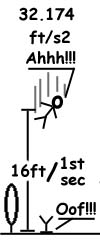
Step one, throw yourself at the ground. Luckily, this is really easy thanks to gravity, which will pull you down to the ground at an acceleration rate of 32.174 feet per second per second, meaning every second you are falling to the ground, you fall 32 feet (9.8 meters) per second faster. If you want to fall for one second, just spend enough energy to climb 16 feet (4.9 meters) above ground and drop. Voila!
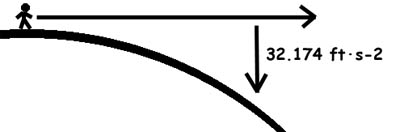
Step two, miss. This is the not so easy part. If you’re reading this, then I assume you are a nerd (like me) and probably still wake up some nights in a cold sweat with nightmares about dehumanizing games such as “Dodge Ball” and possibly even it’s more sadistic cousin “Smear the Queer” from your youth. Now we’re trying to dodge a planet 7926.28 miles (12756.1 kilometers) across at the Equator. Might as well just throw in the towel and brace ourselves for the wedgies, noogies, and nipple cripples. Right?
WRONG!
We don’t have to miss the whole Earth at once, just enough to keep from hitting it each moment. The Moon does this all the time, dodging the Earth faster than it falls toward it - and it’s just a big dumb rock. We don’t want to be dumber than a rock, do we?
Okay then. All we have to do is dodge faster than we fall.
If we fall 16 feet (4.9 meters) in the first second, then we simply have to dodge far enough for the Earth to curve away 16.087 feet below us in one second. Knowing how far to dodge is, as G.I. Joe so wisely said, “half the battle.”
Which brings me to step three, find someone who knows math. In my case, I contacted my brother, Para, who teaches Multivariable Calculus at Georgetown Day School in Washington DC.
Para drew an angle on my circle representing the Earth, “It’s real simple,” he said. “See, sine is the opposite divided by the hypotenuse, cosine is the adjacent divided by the hypotenuse, and tangent is opposite divided by the adjacent. SOHCAHTOA, or Some Old Horse Caught Another Horse Taking Oats Away.” He drew a bunch of equations out for me. “See?”
“Huh,” I muttered.
“I’ve lost you, haven’t I?”
“Um,” I thought about lying, but he’s my brother, he can tell, “yeah.”
“Didn’t you take Trigonometry in high school?”
“Triggawhatromee?”
“Okay,” Para put the pen to his mouth thoughtfully. “I think I see a way to do this with just algebra.”
“Algebra… That sounds familiar. That’s math, right?”
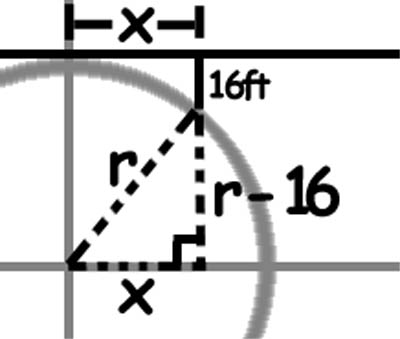
“Hush,” Para drew the following diagram:
Where x is the distance we have to travel for the Earth to curve 16 feet away from under our feet and r is the radius of the Earth. Because we have right triangle and know the radius of the Earth is 20,925,379.2 feet (6.378,055.6 meters), we can use the Pythagorean theorem to find x, like so:
r2 = x2 + (r - 16)2 Which, Para showed me, can be converted to:
x2 = r2 - (r2 - 32r + 256) And then, according to Para, the r’s cancel out, leaving us with:
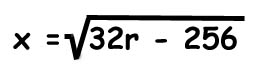
x2 = 32r + 256 Which means x equals the square root of 32r + 256! (Once again, according to Para, so if this is wrong, blame him.)
Plug 20,925,379.2 feet (6.378,055.6 meters) into r and we find that we have to travel 25,876.9 feet (7,887.2 meters) or 4.9 miles (7.0 kilometers) in one second to successfully keep from hitting the Earth. Case closed right?
WRONG! SIT BACK DOWN!
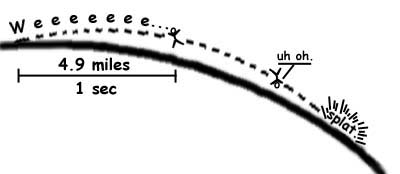
Does stick-man make it? Or is he doomed to a fiery death? To read the exciting conclusion, go here!
Tune in next week for another episode of "Isaac steals cool stuff from better writers"!
Subscribe to:
Posts (Atom)