Aaron of False Vacuum is organizing a workshop on Visual Representation to be held at IHPST in December. Here's the poster:

Bikes can and should behave much more like cars than pedestrians. They should ride on the road, not the sidewalk. They should stop at lights, and pedestrians should be able to trust them to do so. They should use lights at night. And -- of course, duh -- they should ride in the right direction on one-way streets. None of this is a question of being polite; it's the law. But in stark contrast to motorists, nearly all of whom follow nearly all the rules, most cyclists seem to treat the rules of the road as strictly optional. They're still in the human-powered mindset of pedestrians, who feel pretty much completely unconstrained by rules.
The result is decidedly suboptimal for all concerned, but mostly for the bicyclists themselves. New York needs to make a collective quantum leap, from treating bicyclists like pedestrians to treating bicyclists like motorists. And unless and until it does, bike relations will continue to be marked by hostility and mistrust.
 Jane Jacobs was a champion of the neighborhood and enemy of the car. In the last half of the twentieth century, highway systems literally sliced apart neighborhoods, diverted traffic around cities and away from downtown districts. City planning increasingly centered on cars, until Jacobs urged us to "look, listen, linger and think" in neighborhoods - in other words, to remember what we had forgotten while we were driving our cars: neighborhoods are pretty cool places to be.
Start with the caviar and hazelnut foam. Next, try the bacon-stuffed tangerine segment appetizer, and follow with a palate-cleansing sorbet of kiwi and heirloom tomato purée. You'd be a fool to miss the rock lobster meatloaf, which is served atop an oasis of fig and cucumber gelée. Finish with a candied beet root custard and a tassé of chipotle-scented espresso. Bon Appétit!
Haute cuisine fans will descend on Isabel Bader Theatre (93 Charles Street West) this Tuesday, April 29 at 7:00 p.m. to meet Hervé This, the renowned chemist who is credited with coining the term molecular gastronomy and discovering the perfect temperature for cooking an egg (around 65°C). This will be signing copies of his book, Kitchen Mysteries, and giving a lecture on meat glue, liquid nitrogen baths, and other innovations in food science.
 While I'm on the subject of how unions can be annoying, I should mention that I'm a member of a union, too. It represents the teaching assistants at the U of T, and it does a pretty good job of it, at by anecdotal comparison to a few of the US institutions where I have friends. But I do have one big beef with CUPE, and it's that the leadership seem to think international affairs are their business. Social justice is important, but it just isn't appropriate for my local union to make pronouncements about Israel's attitude toward Palestinians. Especially since some of CUPEs membership are Israeli. It puts us all in a bad position. I want my union to devote its energies toward protecting my high pay and keeping up with rising tuition. I care about the plight of Palestinians (and the plight of Israelis generally), but CUPE is just the wrong venue for that discussion.
No, this is the wrong institution or place for us to be doing that.
No, you (or I or we) are the wrong people to be doing that.
No, I know more than you do about what those ideas mean, so don’t try to tell me what to do. You should be listening to me instead.
No, this is an elitist institution that is just appropriating the language of social change for its own ends.
No. Is there a keg anywhere at this meeting?
 Last week, there was talk of a TTC strike. The city's mayor threatened to declare public transit an essential service (like firefighters and police) so that they couldn't strike. So the TTC agreed to give 48-hours notice before walking out. Last Friday, they gave their notice, leaving everyone (well, me anyway) worried over the weekend. Fortunately, at the eleventh hour the city reached a deal with the TTC Union bargaining team, and the strike was averted. All that was left was for the union membership to ratify the agreement, which included upgraded medical coverage and a 6% raise over the next two years.
More:I've kept my strongest views about the TTC to myself, mostly because I am not used to being in a place so heavily unionized, and these views are decidedly anti-union. Whether officially designated as an essential service or not, the TTC is certainly essential to me, though rising costs are making year-round cycling a more and more attractive alternative. Subway trains each have at least two employees on board during operations--a driver and a watcher (she's the one who sticks her head out a window to make sure no one has their foot stuck in the gap before the train leaves a station). I'd eliminate them both, in favor of computerized trains. I'd also change the cash-ticket-token-daypass-weeklypass-monthlypass system to a single card system, where riders could buy single fares, lots of fares at discounted rates, or term-limited unlimited passage. They could purchase cards or add fares to cards at any subway stop (at automated machines that would take cash, debit, or credit), and they could also add fares online. The new card system would involve adding card swipes to buses and streetcars and would allow for the elimination of some of the ticket counter personnel. Also, there would be no advertising anywhere on the TTC. Not on the sides of buses, not in subway stations, and not in subway cars. That's my TTC.
• commentary from transit advocate Steve Munro
• Globe and Mail blog coverage
• Toronto Star coverage
• National Post coverage
• Toronto Sun coverage
• Torontoist coverage
• Blog TO coverage
 To change or not to change? Toronto subway station heritage is being threatened. The 69 stations are stylistically linked with symmetric alternating tile colors, but the TTC recently decided to allow changes to 64 of those stations. Some renovations are already underway, including those at Museum station (before, above; after, below).
 Some Torontonians are upset that "Museum station, a tidy, intact model of TTC subway design that will be tarted up with Egyptian caryatids."
 Toronto doesn't have a good handle on snow. I took this picture about four days after a storm. You can see that most of the snow has melted from rooftops, and the intersections are clear of their usual slush. The giant pile of snow in the lower left partially blocks a driveway, and the snow piles narrow both the roads and sidewalks by half. No space at all is left for the cyclists. Melt-off collects in giant pools at every intersection, which is especially harrowing for parents pushing strollers--they can choose to plow through four to six inches of water, or skirt the puddles by taking to the street. (for better pictures and better analysis, see Spacing.ca)
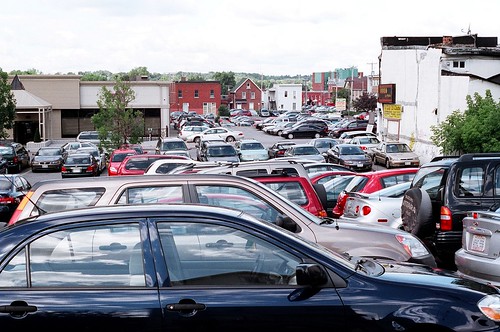 | 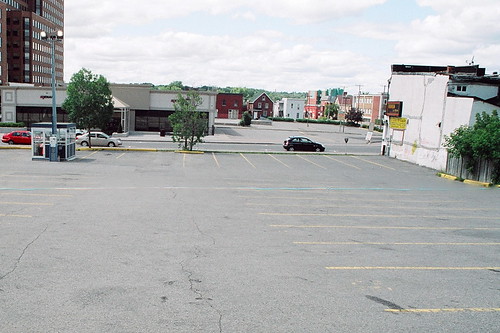 |
there are few frustrations like driving around looking for a parking space, which has its own environmental impacts. Shoup studied a 15-block district in Los Angeles and found that drivers spent an average of 3.3 minutes looking for parking, driving about half a mile each. Over the course of a year, Shoup calculated the cruising in that small area would amount to 950,000 excess miles traveled, equal to 38 trips around the earth, wasting about 47,000 gallons of gas, and producing 730 tons of carbon dioxide that contribute to global warming.
Wonder why the mall parking lot is half empty most of the time? Developers build parking lots to accommodate shoppers on the busiest shopping day of the year -- the day after Thanksgiving -- so that shoppers need never, ever park on the street. Similarly, the church parking lot is designed to accommodate Christmas and Easter services. So a whole lot of land gets paved over that doesn't have to be, transportation planners argue.
usually fades into the background. Or, better, it seeps into our subconscious.That's not entirely true. This happened today, just down the street from my house:
 Yikes.
 It's just down the street from this monstrosity, the Royal Ontario Museum.
 Don't get me wrong; I'm not against modern architecture. I rather like this bit of Wright-inspired tastefulness, the Gardiner Museum, also just down the street.
 I'm not against glass, either, as I'm quite fond of Apple's Fifth Avenue retail store:
 I like the idea of preserving our heritage (top) and building the new and exciting (bottom). But mixing the two can be very dangerous (the ROM). A progressive alien crystalline form engulfing our very heritage may not have been quite the effect the architects intended.
Large cities generate considerable wealth, they are home to many high paying jobs and are seen as engines of innovation. But cities also generate pollution, crime and poor social structures that lead to the urban blight that plagues their very existence.This research suggests that more resources should go toward solving pollution, crime, and social problems—not toward suburbanization. I agree; suburbs are a great evil. I suppose that if cities handled pollution, crime, and social problems better, fewer people would flee to the burbs.

