Showing posts with label travel. Show all posts
Showing posts with label travel. Show all posts
Wednesday, 25 August 2010


Thursday, 19 June 2008
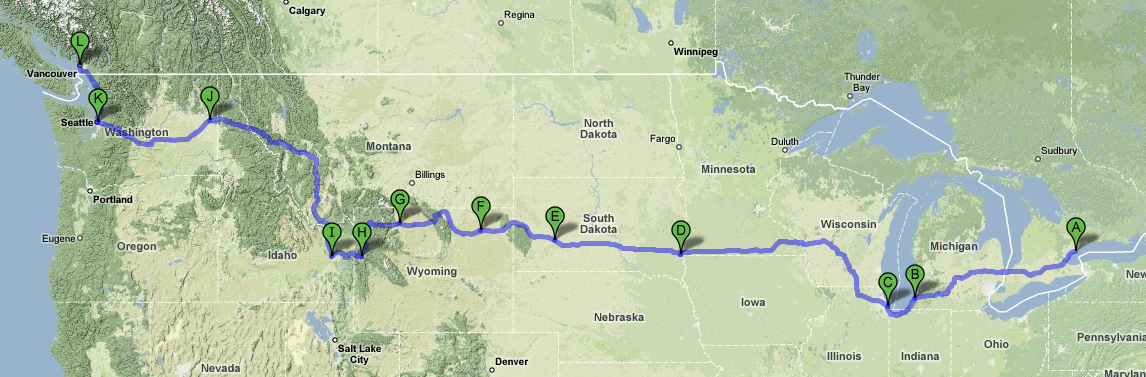
6 days, 10 states, 3000 miles
For those of you wondering what I was up to while I wasn't posting over the past few weeks, I was driving from Toronto to Vancouver, presenting in Vancouver, and then flying back to Toronto. If you want to know more about it, look here.
Friday, 14 March 2008
have space suit, will travel
 British astronomers have agreed to beam a 30-second Doritos ad to a solar system 42 light years from Earth. (via /.) But what price should they advertise?
Paul Krugman's 1978 paper on interstellar trade, a self-described "serious analysis of a ridiculous subject, which is of course the opposite of what is usual in economics," takes on the basic dilemma presented by interstellar travel (near-light-speed). Time passes differently for the beings aboard the trading ship and the planets (the famous "Twin Paradox")--so by whose reference frame should interest be calculated in order to maintain consistent values? Krugman argues that "when trade takes place between two planets in a common inertial frame, the interest costs on goods in transit should be calculated using time measured by clocks in the common frame, and not by clocks in the frames of trading spacecraft." The device allowing this resolution is to suppose that a being could trade in goods or bonds, and because the price of bonds will be set planetside, so should be the price for goods.
This makes good sense, but it does have interesting implications. Consider two business plans:
1) exchange my cash for goods I'll trade on Trantor, get in a ship, go to Trantor, sell the goods for an Earth bond to mature upon my return, get back in my ship, return to Earth, and exchange my bond for cash.
2) exchange my cash for a bond. Wait a long time. Exchange my bond for cash.
There are two differences between these two scenarios: in (1) I take on risk but age only a little, and in (2) I take on less risk but age a lot. In fact, I propose that scenario (3) is effectively equivalent to scenario (1):
3) exchange my cash for a bond. Joyride around the galaxy for a while before returning to Earth. Exchange my bond for cash.
Guess which one I'll be taking to the bank?
Saturday, 10 November 2007
beer and exercise

It turns out, beer is a better post-workout drink than water. There's a study, but I've chosen not to fact-check this one.


a town called Hilvarenbeek

Despite being a very small town, Hilvarenbeek has a windmill, a church, and a hotel. I have not much to say about Hilvarenbeek, except that the bus runs once per hour most of the day (twice hourly in the early morning). Like any good inn, there is an active bar downstairs at the Hotel Brabant. Although lodging away from the cities was inconvenient once or twice, the price was right and I did see a lot more of the countryside than I might otherwise have done.


Saturday, 27 October 2007
models and simulations

I've been to a number of conferences before, but this was my first real conference, meaning that it's the first conference in my field which required travel. And it was great. I can't wait to do it again. After I catch up on my sleep.
The papers given at the conference, Models and Simulations 2, are going to be published in Synthese sometime next year, but I don't think it would be wholly inappropriate to give a bit of a preview and reaction to some of the talks. I'm not entirely sure what etiquette demands, so I'll err on the side of trying to say interesting things (er, perhaps now would be a good time to mention to family and friends that you're welcome to skip this part and just look at the pictures).

Philosophers can't resist an opportunity to blur the distinction between the sublime and the absurd. And so it is that I stood in a room with Paul Humphreys and Bob Batterman and debated the disposition of this projector. I think it was Batterman who suggested the possibility that the cage was there for our protection, perhaps from an evil transforming mechanism. I was getting ready to feel sorry for the poor cyclopean beast -- not only is it caged (and what a cage it is!), but also chained. I'm not sure, but if you look hard enough, I think there's something profound in there.
Perhaps something about philosophers preferring absurdity to silence?
The papers given at the conference, Models and Simulations 2, are going to be published in Synthese sometime next year, but I don't think it would be wholly inappropriate to give a bit of a preview and reaction to some of the talks. I'm not entirely sure what etiquette demands, so I'll err on the side of trying to say interesting things (er, perhaps now would be a good time to mention to family and friends that you're welcome to skip this part and just look at the pictures).
Philosophers can't resist an opportunity to blur the distinction between the sublime and the absurd. And so it is that I stood in a room with Paul Humphreys and Bob Batterman and debated the disposition of this projector. I think it was Batterman who suggested the possibility that the cage was there for our protection, perhaps from an evil transforming mechanism. I was getting ready to feel sorry for the poor cyclopean beast -- not only is it caged (and what a cage it is!), but also chained. I'm not sure, but if you look hard enough, I think there's something profound in there.
Perhaps something about philosophers preferring absurdity to silence?
shadows

Bjorn Lomborg is at it again. A few years back, he made waves with The Skeptical Environmentalist. In it, Lomborg evaluates climate models according to the standards of economic theory, with the punchline that the uncertainties in climate models can't be made to behave enough to cast useful predictions. Now, with Cool It, Lomborg is suggesting that even if climate change is happening, the proposed counteractions are too expensive, particularly given the uncertainty about their efficacy.
One difficulty in economics is in deciding how much to value the future. Here's a concrete example from Lenny Smith, a statistician at LSE. Last year, Lenny's favourite pub flooded. The pub's been around for centuries and it's flooded before, but this was a bad one. The kitchen was ruined. The owner, knowing Lenny has an interest in climate change, asked him a simple question: when I rebuild my kitchen, should I take this opportunity to upgrade my kitchen, or am I going to lose my investment in another flood next year? There's real money at stake, and a decision has to be made without delay. The key to making a good decision is this: what's the discount rate? How many years will be available over which to amortize this investment? Obviously, the time window on economic decisions is crucial. If you just care about the next four years, you get a different answer than if you're planning for the next twenty. In the next four years, it's unlikely that there will be another flood of the same magnitude. But in the next twenty, there might be, especially if the climate changes rapidly. On an even longer scale, say a century, there will almost certainly be another devastating flood at Lenny's pub whether the climate shifts or not. The uncertainty introduced by climate change is how long between disasters?
Discount rates are one tool economists use to constrain their models. This allows them to ignore very long-term, low-likelihood events in order to focus on the here and now. For the most part, this makes sense. When deciding next year's NASA budget, we heavily discount the possibility of an Armageddon-style comet strike. In the long run, it's almost a certainty that there will be a comet strike, but the likelihood of it happening in the next century is quite low. It makes sense to keep thinking about comet strikes, and what we might do about them, but it doesn't make sense to devote a large fraction of our resources to it.
Lomborg's reasoning about climate change is slightly more subtle than this. He's not saying it isn't happening or even that it won't have drastic effects. He's saying climate change will be disadvantageous to some and advantageous to others, and that given our limited resources, we should devote them to problems we know we can fix -- like malaria or cholera. The first point is debatable at best. It's surely true that life on earth isn't threatened by climate change. And some of Lomborg's particular claims may also be right: malaria might disappear from the African sub-continent. But it's important to realize why this might occur: all of the water will have evaporated, turning the fertile lands into desert. Desertification isn't quite the cure most people are looking for. As to the second claim, that we should spend our resources on cost-effective measures, it's hard to argue with the premise, but (again, riffing on Lenny Smith), there's no point in curing AIDs if there aren't any people around to not have it. We have to balance the short and long term, and climate scientists are essentially saying we're discounting too much.
The trouble with Lomborg -- and many climate critics -- isn't that they're wrong about the uncertainties about the future, or the likely ineffectiveness of particular proposed measure. It's that the stakes are too high, and their arguments are being co-opted into a policy of non-action. The Bush administration refuses to sign onto Kyoto because its demands are ineffective. Very well, but he isn't proposing an alternative. In fact, while arguing that we need more information, he's cutting public funding to the National Science Foundation.
But Bush and Lomborg are right about one thing: weather and climate models are tough. It's hard to know what to think about them. Worse, it's hard to know how to think about them. That's where philosophy is supposed to help. It's commonplace that climate models have a lot of uncertainty in them. But what's uncertain? What goes in? What happens in the middle? Or what comes out?
The distinction is crucial. To take a simple example, if I put a glass of water in my freezer overnight, I don't need to know much about the initial conditions to predict that in the morning it'll be frozen (unless my freezer is broken, or I leave the door open, or someone takes the glass out of the freezer, or earth is destroyed by a meteor while I sleep). This is because all initial conditions converge on one outcome: frozen glass of water. The trouble is, climate predictions don't converge. In fact, the results (what comes out) diverge wildly depending on the initial conditions you set (what goes in), or on the parameter values you choose in the model you use (what happens in the middle).
This is exactly what Wendy Parker, a philosopher at Ohio U, works on, and she has some nice things to say. She starts by noticing that models are often developed with a particular circumscribed purpose -- to identify processes, predict within a specified error bound, or simply to describe some phenomenon to a particular audience. Incompatibilities in assumptions or predictions do not necessarily rule out compatibility with respect to any of these purposes. A typical climate model (a physics-based one, rather than just a regression analysis) has initial conditions -- current climate variables, some nonlinear equations with particular parameter values
The trouble with atmospheric science, she says, is that the uncertainties in a given model are often so great that it's difficult to choose a model, even for a proscribed purpose. The "epistemically responsible" choice, at this point, has to be to sample the candidates. This can allow us to find a range of uncertainties or perhaps even a lower bound -- a "non-discountable envelope", to go back to Lomborg. But can we know what's likely to occur?
Woodward has done some work on ensemble explanations, and he suggests criteria for robustness and completeness with respect to some predictive hypothesis H: an ensemble prediction is robust if every candidate predicts H, and it is complete if you know that one of the candidates is actually true. This makes sense, but unfortunately, it just doesn't apply in the case of climate models. In fact, it's more likely that we can show that every candidate is NOT true. Furthermore, the results vary rarely converge on an interesting H. That is, they may all agree the temperature will rise in the next ten years, but the particular predictions may range from 0.1 to 10 degrees.
Again, how do we say what's likely? It's not at all clear that we can just take the probability values that come out of the equations at face value, Wendy says, because they map uncertainty about parameter values onto uncertainty about future climate variables. It's not clear "probability" is even the right category.
As Lenny says, our job doesn't end with running the numbers. We have to explain what they mean. And we just don't have the vocabulary to do that. For a philosopher, that's a call to arms.
Monday, 22 October 2007
Rijksmuseum


There's some nice stuff at the Rijksmuseum, but I was a surprised not to see many of the Dutch Genre paintings I remember Michael Grillo showing in my undergraduate Honors lectures. Paintings from the same period, the Dutch Golden Age (the 17th century) were definitely in evidence, but few of the ones I remember from slides. A common theme at the time was the still life feast: a table overflowing with rich, exotic foods. Dishes of silver, gold, and glass were brimming with oranges, walnuts, oysters, and cakes. Special care was taken to play with reflected color and realism. These paintings represented the cosmopolitan, merchant-class culture of the Netherlands when they were a world power and the Dutch fleet ruled the seas. Vermeer's skill with color is obvious in reproduction, but it is more obvious still when displayed beside contemporary works. Rembrandt's gigantic Nightwatch really is quite amazing, though the cultural significance is clearly lost on me. Back outside, the fog lingers on past eleven in the morning, but the sun is bright and it's beginning to warm up. Just down the street is the Van Gogh museum, where I learned how Vincent was influenced by Japanese art. It's really evident in some of his paintings once you think to look for it. Next door is a temporary exhibit on 19th century Barcelona, where I see some early Picasso.

Outside the Rijksmuseum is this sign, because what Amsterdam really needs is an ad campaign.

No one knows why they take pictures like this. We all do it, though.

Notice how the streets are paved with stone? They do that even with new streets. It's absolutely amazing. Cars, bicycles, and people all get separate pavers.

I'm not sure why someone thought to reproduce Rembrandt's work in bronze, but here it is.

By now quite exhausted, I make my way back to Amsterdam Centraal and hop a train to Tilburg, by way of 's-Hertogenbosch. Past four in the afternoon, I'm dead on my feet, and I fall into a cab to Hotel Brabant in Hilvarenbeek.
Friday, 19 October 2007
7 am

Although it's dark when the plane lands at six, by seven it's possible to see enough to wander, though it's still far too early for any shops to be open. The streets of Amsterdam, like those of most very old cities, do not even approximate a grid shape. I snap this picture of a canal tour routemap and use it to find the sites of sights for the rest of the day:

It's close to nine before I see other people on the street in any numbers, and I'm pretty happy to have had the city to myself for a while, to get my bearings (or lose them?) By now I've completed half a circuit, starting from Centraal Station I've made it down to museumplein. I find some pastry and beat the crowds to the museums.
extra vowels

I'm pretty bad at languages other than English. This is something I discovered in high school Latin, and nothing that's occurred since then has changed my mind about it -- my reading knowledge of French essentially consists in rapid dictionary usage coupled with good logical inference about what English sentence is most likely to have the words I just looked up. I resolved long ago not to let ignorance slow me down, and it's a good thing, or I'd have been a bit frightened to go to the Netherlands. Fortunately for me, everyone there speaks English. And anyhow, a lot of words are cognates to familiar words anyhow, but with some extra vowels added. Centraal Station, for example, is Central Station. That works out pretty well for someone like me.
I'm an entailer. I make detailed plans. Lists, with checkboxes. But not on this trip. I decided to forgo any form of planning beyond flight and lodging. I may have taken things a bit to the extreme. I didn't buy a guidebook or look at a map before I left, so I spent my first half-hour after getting off the plane wandering around Schiphol Airport running my eyes past Netherlands place names on train schedules. Although my present task was simply to get to Amsterdam, I thought it might be wise to check on the route between Amsterdam and Tilburg (the location of the conference, and the nearest train depot to my hotel in Hilvarenbeek). Somehow, I managed to glean that I'd have to head for Utrecht and/or possibly s'Hertogenbosch toward Breda. This settled to the extent it would be before I bought my ticket, I headed for Amsterdam. The plan: wander around for a while and find some food.
if you build it, they will come

One of the very unfortunate facts about Toronto is that no subway line extends to the airport. I can't decide whether it is a passive-aggressive knock at tourists, or a criminally negligent oversight. It is a one hour subway ride from Coxwell to Kipling, a journey made bearable (this time) by a clever innovation of mine: bringing along some specialist readings. From Kipling, it is another half-hour on a bus to the airport itself, followed by the security shuffle and zoned boarding of the 767. My seat? 47. That's out of 50. Finally, three hours after it began, my journey to seat 47 comes to and end, and the six hour flight to Amsterdam commences. The plane lifts off at 17:00 and lands seven hours later at 06:00. This time dilation (compression?) is just such that I have to get up when I'm starting to feel tired enough to sleep. It's dark at 06:00 in Amsterdam.
All my bags are packed...

I take an irrational pride in the fact that I can fit things into small spaces. As with most of my irrational prides, this is one first pointed out to me by someone else. Bending the laws of physics in this way really is a skill of sorts, and it is useful enough that a small amount of pride is probably justified. I take it to extremes, unfortunately, regularly making outlandish claims about being able to fit large stone monuments into small leather pouches. What is most unfortunate about my skill of packing tightly is that it is a necessity, because any space savings I gain stuffing socks into intra-molecular spaces I lose by way of a serious ailment: Overgrown Boy Scout Syndrome (OBSS). "Be prepared," implores the Scout motto, and I take it very seriously. When packing for a trip to Florida in the summer, I will always briefly consider whether I might need my parka. My worst offense is usually shoes. On my trip to San Francisco a few years back, I believe I had two pairs of shoes and sandals. This was a five-day trip, with no hiking excursions or the like planned. In the end, I'm not sure the shoes I chose were really the best for the trip. I long thought OBSS was an incurable lifelong ailment, but I have come to believe that this was just an enabling conviction. If I set a real limit for myself, surely I could make do with less. The goal: fit everything I'd need for a week in the Netherlands into one backpack.
For a while, I thought I was going to have to buy myself a larger backpack to meet my goal. Indeed, I went shopping for one the day before my trip. Ultimately, though, I succeeded, and I now have another skill of which to be irrationally proud.
the notebook

To avoid, at least in part, the creeping fictionalization of memory, I kept a journal of sorts while I was in the Netherlands recently. The idea was that I would record all sorts of interesting observations about Amsterdam (and the conference I attended), take lots of pictures with my new camera, and then post a slightly polished version here, on this blog. As usual, the practice is a bit more complicated, but this is mostly because I was having too much fun to be bothered with writing things down. This is the writer's lament; writing is a reflective activity, for me careful and slow. So despite my good intentions, the following is a reconstruction gleaned from skeletal fragments, scratchy notes in a slim leather-bound journal.
Subscribe to:
Posts (Atom)