Friday, 9 May 2008

what would jane jacobs do?

Jane Jacobs was a champion of the neighborhood and enemy of the car. In the last half of the twentieth century, highway systems literally sliced apart neighborhoods, diverted traffic around cities and away from downtown districts. City planning increasingly centered on cars, until Jacobs urged us to "look, listen, linger and think" in neighborhoods - in other words, to remember what we had forgotten while we were driving our cars: neighborhoods are pretty cool places to be.

Today's ecological pressures seem to be pressing for increasing density in cities, and taller buildings mean fewer neighborhoods. As I walk the streets of Toronto, I see the change all around me. Half a dozen such structures have sprung up within sight of the University of Toronto campus, each tearing down a medium-density neighborhood and replacing it with a twenty-story condominium.

"We are wedging ourselves between a rock and a hard place: between the pleasures of medium-density living (Greenwich Village, Park Slope, Toronto’s Annex) and the ecological necessity of even more density," explains Andrew Blum. He goes on to cite historian William Cronon: "idealizing a distant wilderness too often means not idealizing the environment in which we actually live." Blum's point is that "thinking of cities this way means seeing their density and grit not as the destruction of the environment but as part of its preservation."

The key is to bring together these two apparently discordant senses of "environment": the ecological and the social. Cities need to be proactive and encourage development of mixed-use structures that support inclusion in neighborhoods. I shouldn't think it difficult to reserve the first floor of a condominium for neighborhood shops--a baker, grocer, laundromat, pub, gym, or barber, all accessible from out of doors.

Related: maps of Toronto's high rises and an urban design contest called thinkToronto on spacing.ca.

Thursday, 8 May 2008

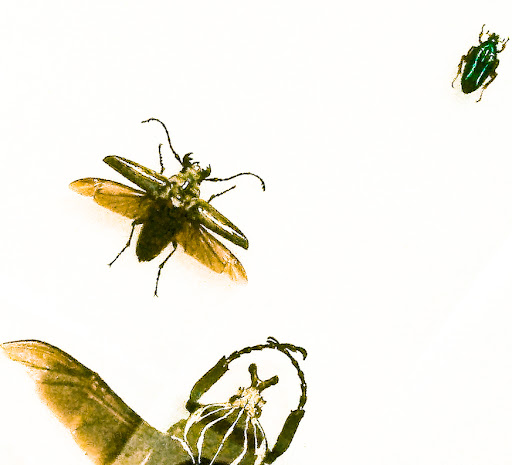
found art?

in fat and real estate, it's all about location, location, location

Kahn's team found some surprising benefits to subcutaneous fat. Mice with subcutaneous fat transplanted into their abdomen gained only about 60% of the weight packed on by the control group, which, like most mice, continued to expand. These transplant recipients also had better glucose and insulin levels. The mice that got extra subcutaneous fat in subcutaneous areas also fared better than controls, although not as well as the first group.
This from sciencenow via 3qd.

Doctors are no doubt working on ways to turn this into an expensive weight-loss surgery in which fat is sucked out of your abdomen and injected directly into your thighs.

Or perhaps Sir Mixalot has it right after all?

Wednesday, 7 May 2008

education kills


[photo by Nirvana]
“These flies died about 20 percent faster than flies with the same genes, but which were not forced to learn.” Forming neuron connections may cause harmful side effects.
I think the lesson here is: invert the question, get a grant. It isn't "why are humans so smart?" It's "why are so many animals so dumb?" As usual, evolutionary biology can "explain" any set of data.

Tuesday, 6 May 2008

change of place, change of mind


Richard Florida in the Boston Globe:
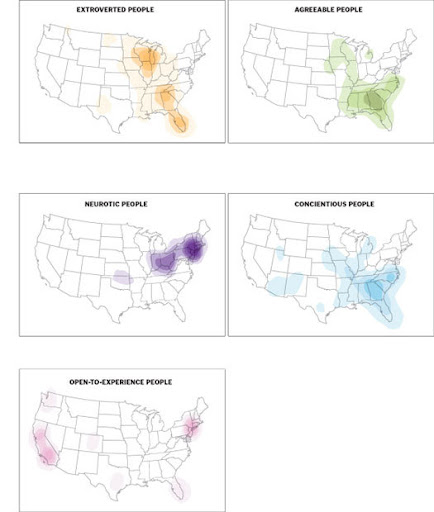
Human personalities can be classified along five key dimensions: agreeableness, conscientiousness, extroversion, neuroticism, and openness to experience.... These personality types are not spread evenly across the country. They cluster.
Florida avoids making causal claims, merely noting the correlation, but just given facts about personality types, he makes one prediction about who will move where:

Conscientious and agreeable types in particular are less likely to move. Once they find a place, they tend to spread out gradually over time. Extroverts, on the other hand, are much more likely to move over greater distances. Open-to-experience types are drawn to thrills and risk, and moving, after all, is one of life's biggest new experiences.

This fuels a process of selective migration whereby agreeable and conscientious regions are drained of the most driven, most creative, and most mobile - only reinforcing their psychogeographic profiles, while magnifying the innovative edge in places where open-to-experience types concentrate.

Florida's previous work on the creative class (see my reaction) suggests that municipalities should work to attract these mobile innovators, but this new work says otherwise. The mobile creative class may be the catalyst for change, but they are not a stable long-term commodity - they may well start up a company and then move on to another location. What's needed to sustain their industry is a reliable supply of conscientious workers balanced with enough innovators to keep the economy sharp. If a region doesn't have enough conscientious workers settled in, it is doomed to a policy of constant roiling turmoil. Too much industry turnover, and the economy will be unable to sustain itself through the rough periods. Too little industry turnover, and the economy will be unable to adapt to keep up with competition.

The billion dollar question is how can a region build a base of conscientious workers - the very people who are less likely to move - without at the same time frightening away the mobile innovators?

hat tip 3 quarks daily

Monday, 5 May 2008

may 5 roundup


  • if you get the joke, you have no right to complain.
  • best time to remember? just before you forget.
  • the LHC as a spam filter: "the LHC will create about a billion collisions per second, and only about 100 of them will actually get stored on hard disk.... the trigger makes some snap judgments about what events are fun."
  • the rationality of single motherhood. Hint: "'Black culture' doesn't explain why the single moms are disproportionately in the states where lots of young black men are in prison."
  • how many people are airborne over the US at any given moment? (the art of estimation)

Tuesday, 29 April 2008

best of net: HOW TO FLY

I'm starting a new series called "best of net" in which I flagrantly quote from lengthy-but-dated posts from other people. First up is a feature from Science Creative Quarterly: "How to Fly." You really should go read it over there.

HOW TO FLY

By Ryan Somma

“The knack of flying is learning how to throw yourself at the ground and miss”

With these words, Douglas Adams helpfully explained concept of flying in his Hitchhiker’s Guide to the Galaxy. But the ground is really big, and, as the Tick so sagely noted, “Gravity is a harsh mistress.” So herein contained is my handy-dandy explanation of how you can impress your friends and family by throwing yourself at the ground and missing:

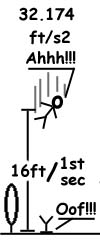
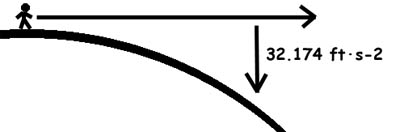
Step one, throw yourself at the ground. Luckily, this is really easy thanks to gravity, which will pull you down to the ground at an acceleration rate of 32.174 feet per second per second, meaning every second you are falling to the ground, you fall 32 feet (9.8 meters) per second faster. If you want to fall for one second, just spend enough energy to climb 16 feet (4.9 meters) above ground and drop. Voila!
ahhh.jpg

Step two, miss. This is the not so easy part. If you’re reading this, then I assume you are a nerd (like me) and probably still wake up some nights in a cold sweat with nightmares about dehumanizing games such as “Dodge Ball” and possibly even it’s more sadistic cousin “Smear the Queer” from your youth. Now we’re trying to dodge a planet 7926.28 miles (12756.1 kilometers) across at the Equator. Might as well just throw in the towel and brace ourselves for the wedgies, noogies, and nipple cripples. Right?

WRONG!

We don’t have to miss the whole Earth at once, just enough to keep from hitting it each moment. The Moon does this all the time, dodging the Earth faster than it falls toward it - and it’s just a big dumb rock. We don’t want to be dumber than a rock, do we?

Okay then. All we have to do is dodge faster than we fall.

If we fall 16 feet (4.9 meters) in the first second, then we simply have to dodge far enough for the Earth to curve away 16.087 feet below us in one second. Knowing how far to dodge is, as G.I. Joe so wisely said, “half the battle.”
fallingtoearth.jpg

Which brings me to step three, find someone who knows math. In my case, I contacted my brother, Para, who teaches Multivariable Calculus at Georgetown Day School in Washington DC.

Para drew an angle on my circle representing the Earth, “It’s real simple,” he said. “See, sine is the opposite divided by the hypotenuse, cosine is the adjacent divided by the hypotenuse, and tangent is opposite divided by the adjacent. SOHCAHTOA, or Some Old Horse Caught Another Horse Taking Oats Away.” He drew a bunch of equations out for me. “See?”

“Huh,” I muttered.

“I’ve lost you, haven’t I?”

“Um,” I thought about lying, but he’s my brother, he can tell, “yeah.”

“Didn’t you take Trigonometry in high school?”

“Triggawhatromee?”

“Okay,” Para put the pen to his mouth thoughtfully. “I think I see a way to do this with just algebra.”

“Algebra… That sounds familiar. That’s math, right?”

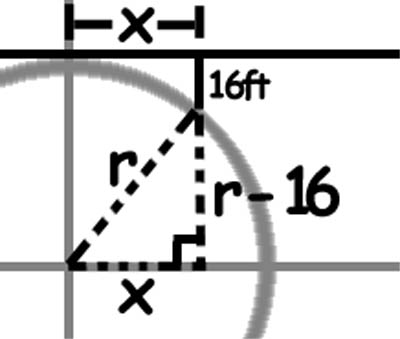
“Hush,” Para drew the following diagram:
pythagorasearth.jpg

Where x is the distance we have to travel for the Earth to curve 16 feet away from under our feet and r is the radius of the Earth. Because we have right triangle and know the radius of the Earth is 20,925,379.2 feet (6.378,055.6 meters), we can use the Pythagorean theorem to find x, like so:

r2 = x2 + (r - 16)2

Which, Para showed me, can be converted to:

x2 = r2 - (r2 - 32r + 256)

And then, according to Para, the r’s cancel out, leaving us with:

x2 = 32r + 256

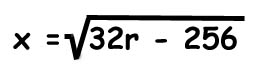
Which means x equals the square root of 32r + 256! (Once again, according to Para, so if this is wrong, blame him.)
xequalssquare.jpg

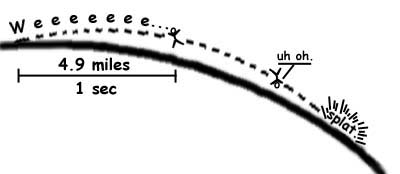
Plug 20,925,379.2 feet (6.378,055.6 meters) into r and we find that we have to travel 25,876.9 feet (7,887.2 meters) or 4.9 miles (7.0 kilometers) in one second to successfully keep from hitting the Earth. Case closed right?

WRONG! SIT BACK DOWN!
weeesplat.jpg

Does stick-man make it? Or is he doomed to a fiery death? To read the exciting conclusion, go here!

Tune in next week for another episode of "Isaac steals cool stuff from better writers"!